A pool light that flickers, dims, or stays dark may point to a transformer issue, but the symptom alone does not prove the cause. Moisture, a loose connection, an incompatible replacement lamp, or a failed fixture can look similar. Learning how to troubleshoot a pool light transformer means checking the whole circuit, not guessing from one dark bulb. Small clues matter. A warm transformer enclosure or a faint buzz deserves attention.
Electrical faults can carry serious consequences. The National Fire Protection Association’s Electrical Fires research tracks fires involving electrical distribution and lighting equipment across U.S. homes. Its findings provide important context, though they do not isolate pool-light transformers. For pool installations, use the transformer’s labeling and manufacturer instructions as practical references. A unit intended for ordinary lighting may not be suitable for a pool system. When a test requires opening equipment or handling wiring, stop and call a qualified electrician. Water changes the stakes.
This guide presents seven practical checks, from confirming power and inspecting visible damage to verifying transformer output with appropriate test equipment. It also explains when troubleshooting should end and professional service should begin. A checklist helps, but it cannot replace sound judgment. Sometimes the honest answer is: do not energize it again.
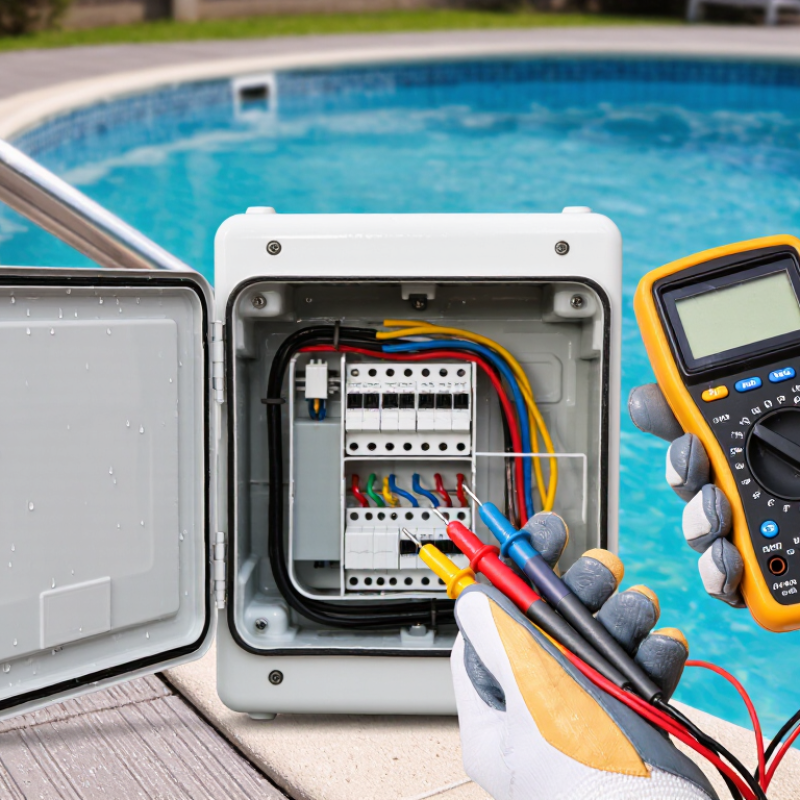
A pool-light transformer may be failing when the light flickers, starts late, or goes dark while the breaker remains on. A persistent buzz, burnt-plastic smell, unusual warmth, or corrosion near the enclosure also deserves attention. Not normal. A faint hum alone does not prove a fault, though; judging by sound is an easy mistake. Note when symptoms occur, such as after rain or when the light has been on for several minutes. Never open energized equipment or touch wet electrical fittings. Switch off the circuit if there is a burning smell, visible water, or repeated tripping, then contact a qualified electrician.
Electrical faults can have serious consequences around water. The NFPA report Electrical Fires (2015–2019) estimated 46,700 U.S. home fires per year involving electrical failure or malfunction, with an average of 390 civilian deaths annually. These figures are not pool-specific, but they show why recurring electrical symptoms should not be ignored. The U.S. Consumer Product Safety Commission’s 2024 Pool or Spa Submersion report estimated an annual average of 6,300 emergency-room-treated, nonfatal drowning injuries among children under 15 for 2021–2023. Those incidents were not attributed to transformer faults; they underline the need to keep pool areas carefully supervised while repairs are arranged. Check that protective devices are present and functioning, but leave testing and transformer replacement to a trained professional.
Example AC waveforms for a nominal 120 V to 12 V transformer. The plotted values are idealized peaks; actual voltage depends on the transformer, load, and supply. Always check the equipment nameplate.
How to read it: The primary and secondary waveforms share the same frequency, while the secondary voltage is lower. A missing or abnormal output can indicate a supply, connection, transformer, or load problem; this chart is illustrative, not a diagnostic measurement.
Safety: Pool-light circuits can present a potentially fatal shock risk. Do not open energized equipment or probe wiring near water. Switch off the correct circuit and have a qualified electrician verify it is de-energized before inspection.
Before blaming the pool light transformer, check whether the circuit has power. From a dry location, look for a tripped breaker and a tripped GFCI outlet or protective device. Keep your hands dry. Never stand in water or handle electrical controls while wet. A tripped breaker may sit between ON and OFF, so move it fully to OFF before resetting it. Then switch it back on once.
Check the GFCI’s TEST and RESET buttons according to its instructions. If it will not reset, or trips again when the light is switched on, stop there. Repeated trips can point to moisture, damaged wiring, a faulty light, or a transformer problem; they are not a reason to keep resetting the circuit. Note what happens and when. That detail helps a qualified pool electrician narrow down the fault. I’ve found that a breaker that appears normal can still hide a problem, so visual checks are only a first clue. Do not remove covers or probe wiring near the pool. Electrical faults around water deserve careful attention.
| 7 Best Ways to Troubleshoot a Pool Light Transformer — Check the Pool Light Circuit, Breaker, and GFCI | ||||
|---|---|---|---|---|
| Step | What to Check | Safe Action | What the Result May Indicate | When to Call a Qualified Electrician |
| 1 | Confirm the light has power and note what is happening. | Use the normal wall switch or pool-light control. Record whether the light is off, flickering, dim, or trips a protective device. | A completely dark light may point to a control, circuit, connection, transformer, or lamp issue. Flickering or repeated tripping needs prompt investigation. | If there is a burning smell, visible damage, buzzing, or repeated breaker or GFCI trips, stop using the light and arrange an inspection. |
| 2 | Check the circuit breaker. | From a dry location, check whether the labeled pool-light breaker is tripped. If it is, reset it only once according to the panel instructions. | If the breaker stays on, the interruption may have been temporary. If it trips again, a fault or overload may be present. | If the breaker will not reset or trips again, leave it off. Do not repeatedly reset it or remove the panel cover. |
| 3 | Check the GFCI protection. | Locate the GFCI device identified for the pool-light circuit. Check its status and, if conditions are dry and safe, use its test and reset buttons as directed on the device. | A GFCI that trips can indicate leakage current or another electrical fault. A device that will not reset may have no supply power or may need professional diagnosis. | If it trips again, will not reset, or shows signs of moisture or damage, keep the light off and contact an electrician familiar with pool installations. |
| 4 | Inspect accessible controls and connections visually. | With the circuit switched off, look for obvious damage, corrosion, loose covers, or water around accessible control or transformer enclosures. Do not open enclosures. | Moisture, corrosion, or physical damage can interfere with operation and may create a shock hazard. | Have damaged, wet, or corroded equipment inspected and repaired. Do not touch wet electrical equipment. |
| 5 | Check the transformer’s rating and compatibility. | Read the information on the exterior label, if safely accessible. Compare the stated input and output ratings with the pool-light manufacturer’s requirements. | An incorrect voltage rating, unsuitable transformer, or load beyond its stated capacity may prevent reliable operation or damage equipment. | Ask an electrician to verify compatibility and capacity. Do not substitute a transformer based only on appearance or connector fit. |
| 6 | Consider the lamp or light assembly as a possible cause. | Check the light manufacturer’s instructions for lamp type and service requirements. Do not remove a pool light or handle it while connected to power. | If the supply and transformer are functioning, a failed lamp, LED module, seal, or internal connection may be responsible. | Pool-light removal, sealing, and electrical testing should be performed by a qualified professional to preserve watertight integrity and electrical safety. |
| 7 | Have the circuit and transformer tested professionally. | Ask a qualified electrician to test the supply, protective devices, transformer output, grounding and bonding, and relevant connections using appropriate procedures. | Testing can distinguish a failed transformer from a wiring fault, control problem, or defective light assembly. | Do not probe live wiring or measure voltage yourself near a pool. Electrical work around pools can be hazardous; keep the light off until a suspected fault is resolved. |
Inspect the pool-light transformer with the circuit switched off and verified de-energized. Water and electricity leave little room for guesswork. Have a qualified electrician check the supply, grounding, and low-voltage output, especially if the enclosure is damp. Look for loose terminals, green corrosion, darkened insulation, cracked cable jackets, or a burnt smell. Small clues matter. Compare the wiring with the transformer’s diagram; mismatched input and output connections can damage equipment or create a shock hazard.
Check the enclosure and mounting surface, too. Rust streaks, pooled condensation, a swollen casing, or a persistent hum deserve attention. Keep the cover and seals intact, and don’t probe energized terminals yourself. If a connection feels loose, resist the urge to tighten it while power is on. That shortcut is not worth the risk.
The NFPA’s 2022 Electrical Fires report estimated an annual average of 46,700 U.S. home structure fires involving electrical failure or malfunction from 2015 to 2019. Those figures are not specific to pool transformers, but they underline why damaged wiring should not be dismissed. A visual inspection has limits. If the transformer’s condition, wiring diagram, or output rating is unclear, ask a licensed electrician to test it with suitable equipment.
Set a digital multimeter to AC volts and check the transformer’s primary terminals against its nameplate. For a nominal 120-volt supply, ANSI C84.1-2020 gives a Range A service-voltage band of 114–126 volts. A reading outside that range may point to a supply or wiring issue, not a failed transformer. Work around live terminals only if qualified; keep test leads dry and secure.
Then measure the secondary terminals and compare the reading with the transformer’s rated output and selected tap. Do not assume every pool light uses the same voltage. Record the reading with the light disconnected, then—if safe and appropriate—check again under load. An unloaded reading can look reassuring, yet a loose connection or failing winding may show itself only when current flows. Note the exact tap and load conditions; small details matter. NFPA’s Electrical Fires report documents thousands of U.S. home fires involving electrical failure or malfunction each year, a reminder that careful diagnosis matters. Never bypass protective devices to get a reading. If input voltage is normal but output is absent, unstable, or far from the nameplate rating, stop and have a qualified pool electrician inspect the unit.
If the transformer hums, smells burnt, or shows heat damage, switch off the circuit breaker and keep the pool light off. Do not open or test energized equipment. A qualified electrician can confirm whether the transformer has failed or whether the fault lies in the lamp, wiring, or protective device. That distinction matters; replacing a good transformer will not fix a damaged cable.
When replacement is needed, match the transformer’s input and output ratings, capacity, and suitability for pool lighting. Check the fixture requirements rather than guessing from the old unit’s appearance. The enclosure, wiring connections, and grounding or bonding must also be inspected for corrosion or moisture. Small details count. Once repairs are complete, the electrician can restore power, test the GFCI and switch, and verify that the light operates steadily. Watch from a dry, safe location. If it flickers, trips protection, or fails to illuminate, turn it off again and have the circuit checked. I have seen a rushed replacement mask a wiring problem; retesting is not optional.
With power switched off and verified de-energized, look for loose terminals, green corrosion, dark insulation, cracked cable jackets, or a burnt smell. Small clues matter. Keep the cover and seals intact.
Never tighten or probe energized terminals. Have a qualified electrician inspect the wiring, especially if the enclosure is damp or corroded. Water changes the risk.
Persistent humming, a swollen casing, rust streaks, or pooled condensation deserve attention. Turn off the circuit and keep the light off until a qualified electrician checks it.
A reference range for nominal 120-volt service is 114–126 volts. A reading outside that range may indicate a supply or wiring issue, not necessarily a failed transformer.
A qualified person should compare the secondary reading with the unit’s nameplate and selected tap. Pool lights do not all use the same voltage. Do not guess.
An unloaded reading can seem normal, while a weak winding or loose connection may fail under load. Record the tap and test conditions. I might still miss a fault without proper equipment.
First, have a qualified electrician determine whether the fault is in the transformer, lamp, wiring, or protective device. A new transformer will not repair damaged cable.
The electrician should check the GFCI and switch, then confirm the light operates steadily. Watch from a dry, safe location. If it flickers, trips protection, or stays dark, turn it off again. Retesting matters.
Learning how to troubleshoot a pool light transformer starts with recognizing warning signs, such as a light that flickers, fails to turn on, or causes a breaker or GFCI to trip. Because water and electricity are a dangerous combination, switch off power at the breaker before inspecting anything, and avoid handling electrical components while they are energized. Check the pool light circuit, breaker, and GFCI for trips or visible damage, then inspect the transformer’s wiring, connections, and enclosure for loose terminals, corrosion, or signs of overheating.
If the circuit and connections appear sound, use an appropriate meter to check the transformer’s input and output voltage, following the equipment instructions and keeping safety precautions in mind. A faulty supply, damaged wiring, or failed transformer may explain why the light does not work. Repair only issues you are qualified to address; replace a defective transformer with a compatible unit, then restore power and retest the light. If the cause is uncertain, have a qualified electrician inspect the system.
